Monday, October 22, 2012

HOMEWORK THIS WEEK

Since we are retaking our BIG test from a few Mondays ago, you are responsible for studying your notes on a DAILY basis!  We have a test this Wednesday and also this Friday, that should catch us up with our first chapter.  Those who score below 70% will be retaking the test next week.

STUDY... did I say Study>??? oh remember to STUDY!

Mr. Rott's Room Blog 10-22-12

WELCOME TO OUR JUNGLE SAFARI! Class Blog 10/22/12
Well winter is here... it sure did rain a lot last night!  As good old Mr. Busch used to say, “I can’t believe that we are almost into November!”  That is for sure!  We took our first chapter test, I appreciated how hard you worked, yet also many of you, actually TO MANY of you did not even study for the test and your grades show it.  As a result many of you will be retaking a test similar to the one you just had.  If you do not learn to study during Jr. High School, I am guessing that your study habits will suffer in High School.  Please put your best effort into all your work! 

Math A, 2nd and 4th Period:
This week we will be working on multiplying decimals along with preparing for tests on rounding and ordering decimals.

Math B, 5th period
We will be studying for a test on solving equations, simple and mutiple equations.  Also we will begin working on solving linear equations.

Blog Jungle Fact for the Week:
NO BLOG QUESTION THIS WEEK!
    

   GOOOOOOOOOOOOOOOOOOOOOOO                    ZAGSSSSSSSSSSSSSSSSSSSSSSSSSSSS

FEEL THE SPIRIT!!!  Each week brings us closer to another FANtastic season of ZAG basketball!

SCHEDULE:
Southern Utah Thunderbirds Friday, November 09 2012
West Virginia Mountaineers Monday, November 12 2012
South Dakota Coyotes Sunday, November 18 2012
Clemson Tigers Thursday, November 22 2012
Pacific Tigers Saturday, December 01 2012
@ Washington St. Cougars Wednesday, December 05 2012
Illinois Fighting Illini Saturday, December 08 2012
Kansas St. Wildcats Saturday, December 15 2012
Campbell Fighting Camels Wednesday, December 19 2012
Baylor Bears Friday, December 28 2012
@ Oklahoma St. Cowboys Monday, December 31 2012
@ Pepperdine Waves Thursday, January 03 2013
@ Santa Clara Broncos Saturday, January 05 2013
St. Mary's, Calif. Gaels Thursday, January 10 2013
@ Portland Pilots Thursday, January 17 2013
@ Butler Bulldogs Saturday, January 19 2013
BYU Cougars Thursday, January 24 2013
San Francisco Dons Saturday, January 26 2013
@ Loyola Marymount Lions Thursday, January 31 2013
@ San Diego Toreros Saturday, February 02 2013
Pepperdine Waves Thursday, February 07 2013
Loyola Marymount Lions Saturday, February 09 2013
@ St. Mary's, Calif. Gaels Thursday, February 14 2013
@ San Francisco Dons Saturday, February 16 2013
Santa Clara Broncos Wednesday, February 20 2013
San Diego Toreros Saturday, February 23 2013
@ BYU Cougars Thursday, February 28 2013
Portland Pilots Saturday, March 02 2013

Even though life can seem to be wild and crazy... or that your lost in a jungle.. Keep pressing forward! And always remember, you are amazing, incredible people with the whole world waiting to be changed by YOU!

Mr.  Rott

Friday, October 12, 2012

Mr. Rotts' room Blog for October 15 - 19

WELCOME TO OUR JUNGLE SAFARI!
Class Blog 10/15/12  
What a treat that you get Friday off... I am writing this on Thursday... hopefully the weather
channel is incorrect and it won’t rain this weekend! Either way I hope that you had a great day
off!


Math A, 2nd and 4th Period: CHAPTER TEST MONDAY!!
This week we will be working on multiplying by 2 digits.. this is something that you have had in
the past and I am sure we will fly through it like George of the jungle on a vine!
 

Math B, 5th period CHAPTER TEST MONDAY!!
We will be working on a little more of the 1 and 2 step equations.. and then really focus on multistep equations... it can get confusing.. so make sure you study your notes every night!
 

Blog Jungle Fact for the Week: Poisonous Animals in the Amazon Rainforest
USA Today.. .has an article about poisonous animals in the Amazon... they say...
“Project Amazonia indicates an estimated 500 mammal species and over one million insect species dwell within the Amazon rain forest. Many of these animals developed natural toxins as they evolved, a characteristic which can serve to discourage predators or enable venomous animals to efficiently kill their prey. In addition to species that are genuinely poisonous, the Amazon is home to creatures exhibiting Batesian mimicry characteristics, sporting colors and markings similar to those of poisonous fauna, without actually being poisonous themselves.


Amphibians
Over 100 species of poisonous dart frogs dwell within the Amazon, and while these frogs are tiny, growing no larger than 2.5 inches long, a single frog can store enough venom within its flesh to kill ten humans. The frogs' neon-bright colors and speckled bodies warn potential predators of their toxicity, though some indigenous Amazon tribes find the frogs useful, coating the tips of projectile weapons with the frogs' venom. Cutaneous chytridiomycosis is a fungal parasite that's potentially lethal to the frogs. In his book, "No Rain in the Amazon," author Nikolas Kozloff notes that global warming is increasing humidity within the Amazon, allowing the fungus to thrive at the expense of the region's dart frog populations.

 
Butterflies
The Amazon is home to poisonous Heliconius butterfly species, such as Heliconius erato and Heliconius melpomene, whose bright red wing markings warn predators of their toxicity. During their caterpillar stage, Heliconius species ingest the toxic leaves of poisonous flora, relying on specialized enzymes to neutralize the toxins. The repeated intake of toxins make Heliconius species poisonous to avian predators during both their caterpillar and butterfly stages.


Pit Vipers
The pit vipers of the Amazon take their name from the indentation within their snouts. The pits detect body heat, directing the snakes toward their prey. A pit viper coils immediately before striking, then injects venom into its prey's bloodstream through its long, hollow fangs. Amazonian pit vipers include the Bushmaster, which can grow to 12 feet long, making it both the world's largest pit viper and the Western Hemisphere's longest poisonous snake. The nocturnal fer-de-lance can grow to over 6.5 feet in length, and is rarely seen during daylight, preferring to stalk its prey between dusk and mid-evening.
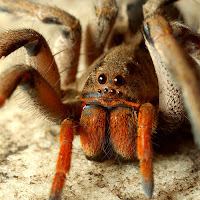
Spiders
While the spiders of the Amazon use venom to kill or immobilize their prey, very few pose a danger to humans. Even tarantula bites are relatively harmless, except to those who suffer an allergic reaction to the spider's venom, though the toxin within their body hair can irritate skin. The Brazilian wandering spider is a notable exception, with venom that contains a neurotoxin that's potentially life-threatening, causing severe pain as it spreads throughout the victim's body. While most Amazonian spiders shy away from humans, Brazilian wandering spiders aggressively attack people who arouse their attention. These spiders are commonly found beneath fallen trees within the rainforest, as well as within the walls of thatched houses.”
 

Blog Questions - MAKE SURE YOU HAVE READ OR LISTENED TO THE BLOG FACT FOR THE WEEK!
1) If the Brazilian wandering spider wanders at 1.5 miles per hour, how far could it travel in 3
hours?
2) If you took 15 tree frogs and lined them up... being careful NOT to touch the frogs skin, how long will the line of frogs be?
3) If a Pit Viper eats 5 rats a week... how many rats will a Viper (not talking the car ..hahaha) eat in a month?


                               GONZAGA BASKETBALL
 FEEL THE SPIRIT!!! Well we have a start to a schedule... either way the seasons is just around the corner!
 

SCHEDULE:
Southern Utah Thunderbirds Friday, November 09 2012
West Virginia Mountaineers Monday, November 12 2012
South Dakota Coyotes Sunday, November 18 2012
Clemson Tigers Thursday, November 22 2012
Pacific Tigers Saturday, December 01 2012
@ Washington St. Cougars Wednesday, December 05 2012
Illinois Fighting Illini Saturday, December 08 2012
Kansas St. Wildcats Saturday, December 15 2012
Campbell Fighting Camels Wednesday, December 19 2012
Baylor Bears Friday, December 28 2012
@ Oklahoma St. Cowboys Monday, December 31 2012
@ Pepperdine Waves Thursday, January 03 2013
@ Santa Clara Broncos Saturday, January 05 2013
St. Mary's, Calif. Gaels Thursday, January 10 2013
@ Portland Pilots Thursday, January 17 2013
@ Butler Bulldogs Saturday, January 19 2013
BYU Cougars Thursday, January 24 2013
San Francisco Dons Saturday, January 26 2013
@ Loyola Marymount Lions Thursday, January 31 2013
@ San Diego Toreros Saturday, February 02 2013
Pepperdine Waves Thursday, February 07 2013
Loyola Marymount Lions Saturday, February 09 2013
@ St. Mary's, Calif. Gaels Thursday, February 14 2013
@ San Francisco Dons Saturday, February 16 2013
Santa Clara Broncos Wednesday, February 20 2013
San Diego Toreros Saturday, February 23 2013
@ BYU Cougars Thursday, February 28 2013
Portland Pilots Saturday, March 02 2013
 
Even though life can seem to be wild and crazy... or that your lost in a jungle.. Keep pressing forward! And always remember, you are amazing, incredible people with the whole world waiting to be changed by YOU!

Mr.Rott

Wednesday, October 10, 2012

NOTES up for Mondays tests!


Yes... indeed... the notes are up for this coming Mondays.... Chapter test!  Be an explorer and EXPLORE the notes for your test.... it won't hurt!

Monday, October 8, 2012

Class NOTES


Just to remind you that almost daily I post the notes from class................. if your not sure how to do homework or what your doing.. please check out the class notes!
Be cool.. don't drool math RULES!

Friday, October 5, 2012

WELCOME TO OUR JUNGLE SAFARI! Class Blog 10/8/12

WELCOME TO OUR JUNGLE SAFARI!
 Class Blog 10/8/12
Another week... you continue to amaze me and teach me things every day!  This Friday will be your first day off... I hope that you’ll have a great day off!  Remember work hard then play hard!


!!!!!!!!!!!!!!!!!!!!!!!!!!!!!!!!!!!!!!!!!!!!  MAKE SURE THAT YOU DO YOUR BLOG QUETIONS BEFORE YOU WATCH THE VIDEOS... THE VIDEOS ARE FOR LEARNING ABOUT THE BLOG SUBJECT NOT TO KEEP YOU FROM WORKING...!!!!!!!!!!!!!!!!!!!!!!!!!!!!!!!!!!!

Math A, 2nd and 4th Period:
This week we will be working on adding and subtracting decimals along with that we will be reviewing decimals for a section test on Monday October 15th.  That will give you Friday, Saturday and Sunday to study... please take the time to study...

Math B, 5th period
You all did great with the jungle 1 step dance... and now its time for the Jungle 2-step.... there was a time when I could dance the two-step... perhaps I will show you my crazy dance moves! On Wednesday and Thursday we will be having a review to get ready for a section test on Monday October 15th.  That will give you Friday, Saturday and Sunday to study... please take the time to study...

Blog Jungle Fact for the Week: 
Survival in the Jungle
Step 1
Steady your nerves, according to the tourism website Travel Overseas. If you’re separated from your fellow travelers or you’ve survived a plane crash, your first instinct might be to panic. Panic exhausts the body and exponentially increases its need for water and food. Sit quietly for a while to gather your thoughts and take inventory of your supplies. If you survived a plane crash, search the wreckage for potable water, fresh food, a knife, waterproof materials, blankets, first-aid supplies and any other gear that might help you survive.
 

Step 2
Keep your skin covered. Roll down your sleeves and cover your face as much as you can to avoid scratches and insect bites. Wear pants instead of shorts. Treat any wounds immediately and as properly as possible.
 

Step 3
Obtain water. Dense masses of insects often indicate a nearby water source, according to Travel Overseas. Bees usually build their hives within a couple of miles of a body of water, and flies typically stay within 300-350 feet of water. Whenever possible, boil the water you find, filter it or add purification tablets to it.

Step 4
Wear waterproof shoes or rubber jungle boots. If these aren’t available, wrap your feet in plastic bags before putting on your shoes. Never wear wet socks. Over time, chronic moisture can lead to tissue breakdown and leave feet vulnerable to fungus and other infections. Costa Rica Rainforest Outward Bound advises applying moleskin or duct tape to hot spots and using foot creams or powders to treat fungus or bacteria. Cover any blisters and drain them from the bottom with a sterilized needle, but only if absolutely necessary.


Step 5
Head downhill. In 1971, 17-year-old Julia Kopecke was the lone survivor of a 92-passenger flight that crashed in the Peruvian rain forest. Although in shock, she recalled her father’s advice: “Heading downhill in the jungle leads to water and water leads to civilization.” After bushwhacking through the forest for 10 days, the teenager stumbled across a hunter’s hut and was eventually reunited with her father.
 

Step 6
Leave a trail, according to Travel Overseas. As you're hiking through the jungle, make markers from torn clothing or any brightly colored or reflective objects you can find. Don’t create a trail from anything edible, as animals will consume it. Don’t head in a straight line, either. Constantly look ahead for gaps in the rain forest, and conserve your energy by making slow and steady progress. Use a long branch as a walking stick and to clear foliage from your path. Avoid grabbing vines or plants while making your way up slopes, as many rain forest plants have thorns and emit irritants.
 

Step 7
Find or build a shelter. Use whatever materials you have or can find to protect yourself from heavy rains and flooding, insects, and poisonous spiders and snakes. Take shelter on the highest ground possible and build fires to frighten away predators and signal for help.

 
Step 8
Eat berries, fruits, vegetables and nuts with which you’re familiar to avoid the risk of accidental poisoning. Look for coconuts, squash, cucumber, cashews, peanuts and citrus fruits, all of which are plentiful in the Amazon. If you’re able to find fruit or catch fish from a lake or river, don’t hoard it, as it will attract wildlife and spoil quickly in the tropical heat and humidity.

Fear - For anyone faced with a wilderness emergency survival situation, fear is a normal reaction. Unless an emergency situation has been anticipated, fear is generally followed by panic then pain, cold, thirst, hunger, fatigue, boredom and loneliness. It is extremely important to calmly assess the situation and not allow these seven enemies to interfere with your survival.


Pain - Pain may often be ignored in a panic situation. Remember to deal with injuries immediately before they become even more serious.

Cold - Cold lowers the ability to think, numbing the body and reducing the will to survive. Never allow yourself to stop moving or to fall asleep unless adequately sheltered.

Thirst - Dehydration is a common enemy in an emergency situation and must not be ignored. It can dull your mind, causing you to overlook important survival information.  How long can you live without water? A person can survive only three to five days without water, in some cases people have survived for an average of one week. It is not recommended that anyone try this at home. Once the body is deprived of fluids the cells and organs in the body begin to deteriorate. The presence of water in the body could mean the difference between life and death.

Hunger - Hunger is dangerous but seldom deadly. It may reduce your ability to think logically and increase your susceptibility to the effects of cold, pain and fear.

Fatigue - Fatigue is unavoidable in any situation so it is best to keep in mind that it can and will lower your mental ability. Remember that in an emergency situation this is often the bodies way of escaping a difficult situation.

Boredom & Loneliness - These enemies are quite often unanticipated and may lower the mind's ability to deal with the situation.  

 
Blog Questions: See Blog Jungle Fact For the Week
1) If a bee only fly's 350 feet from water... then what would 350 look like in standard form and expanded form?

2) If you were lost in the jungle for 3 days... how many hours would that be and how many seconds would that be?

3) If you are lost in the jungle, with no water... about how long could you live?  How many glasses of water do you drink every day?

4) What would you most worry about if you were lost in the Jungle?

        
FEEL THE SPIRIT!!!


Fall is in the air and that means ONE thing... GONZAGA BASKETBALL!

SCHEDULE:
October 27 vs. Northwest Nazarene University (Exh)
November 09 vs. Southern Utah University
November 12 vs. West Virginia University - 9:00 p.m.TV: ESPN   
November 18 vs. University of South Dakota
November 22 vs. Clemson University - 6:00 p.m. TV: ESPN2  

Even though life can seem to be wild and crazy... or that your lost in a jungle.. Keep pressing forward! And always remember, you are amazing, incredible people with the whole world waiting to be changed by YOU!

Mr. Rott


Friday, September 28, 2012

WELCOME TO OUR JUNGLE SAFARI! Class Blog 10/1/12

WELCOME TO OUR JUNGLE SAFARI! Class Blog 10/1/12
 

 Wow...its already October.... this month sure did go fast.. You have officially finished your first month of school for the year!! 8th graders are one month closer to graduating... now that is exciting! 
Math A, 2nd and 4th Period
This week we will be working on estimating with decimals and then entering into the jungle to hunt those dangerous adding and subtracting decimals... such scary little creatures!  

Math B, 5th period
It’s time to do the jungle 1 step dance... haha... no really that’s the two step which is next week!... we will be working on 1 step equations... .

Blog Jungle Fact for the Week: The Jungle Leopard 
Generally leopards will eat any warm-blooded prey, from mice and hares to large antelope. But a leopard is the supreme opportunist and will also eat birds, reptiles, rodents and even insects. If living close to people, it will also attack domestic animals and pets such as dogs.

When there are no large predators or vultures in the area, a leopard will leave its kill on the ground covered with loose soil or leaves. Otherwise it will carry its prey up a tree.

Leopards will also scavenge if necessary, stealing kills from cheetahs, lone hyenas and any of the smaller carnivores. Excess food is stored to be eaten later and leopards have been observed killing again before the first carcass is completely eaten.
-Leopards are part of the cat family, Felidae. The scientific name for a leopard is Panthera pardus.
-Leopards are well known for their cream and gold spotted fur, but some leopards have black fur with dark spots. These black leopards are often mistaken for panthers.
-Adult leopards are solitary animals. Each adult leopard has its own territory where it lives and, although they often share parts of it, they try to avoid one another.
-A leopard’s body is built for hunting. They have sleek, powerful bodies and can run at speeds of up to 57 kilometres per hour. They are also excellent swimmers and climbers and can leap and jump long distances.

 -A leopard’s tail is just about as long as its entire body. This helps it with balance and enables it to make sharp turns quickly.
-Leopards are mostly nocturnal, hunting prey at night.

-Leopards protect their food from other animals by dragging it high up into the trees. A leopard will often leave their prey up in the tree for days and return only when they are hungry!
-Female leopards give birth to a litter of two or three cubs at a time. By the time a cub is two years old it will leave the company of its mother and live on their own.
Some people believe that the bones and whiskers of leopards can heal sick people. Many leopards are killed each year for their fur and body parts and this is one reason why the leopard is an endangered animal. While they were previously found in the wild in a number of areas around the world, their habitat is largely restricted to sub-Saharan Africa with small numbers also found in India, Pakistan, Malaysia, China and Indochina.
-Larger than female leopards, male leopards can weigh from 82 to 200 pounds (37 to 91 kg).
-Leopards are the most successful and cunning among big cats.
-Like most cats, leopards are solitary creatures that hunt mainly at night.
-Leopards have a very beautiful coat with a tawny background and rosettes, that aids them in camouflage.

-The Clouded Leopard has the longest canines amongst cat species.

-Leopards are masters of stealth and extremely difficult to trace and locate in the wild.
-Pound for pound, leopards are the strongest among big cats.
-Leopards are the best tree climbers amongst big cats and are capable of taking prey that is twice their body weight, up a tree.

-Leopards are territorial animals and regularly mark and defend their domain against intruders.
Blog Questions: 
1) A leopard drags its food 15.5 feet to a tree that was 13.86 feet away... order these decimals from smallest to largest.. And what was the total distance that the leopard dragged its food?
2) If you went to the jungle and saw 13 Leopards... what would their total weight be.. taking the largest weight listed?
3) How fast does a Leopard run, use the below converter to find out!
http://www.calculateme.com/Speed/KilometersperHour/ToMilesperHour.htm  
4) What is ONE fact that you learned about Leopards after watching the videos?
8) If there is a large group of leopards... and there are 4 females who have cubs... how many cubs might you find?


FEEL THE SPIRIT!!!  
Well we have a start to a schedule... either way the seasons is just around the corner!SCHEDULE:
October 27 vs. Northwest Nazarene University (Exh)
November 09 vs. Southern Utah University
November 12 vs. West Virginia University - 9:00 p.m.TV: ESPN   
November 18 vs. University of South Dakota
November 22 vs. Clemson University - 6:00 p.m. TV: ESPN2 

Even though life can seem to be wild and crazy... or that your lost in a jungle.. Keep pressing forward! And always remember, you are amazing, incredible people with the whole world waiting to be changed by YOU!

Mr. Rott

Friday, September 21, 2012

WELCOME TO OUR JUNGLE SAFARI! Class Blog 9/24

Another week has flown by... amazing how fast time goes by when your exploring the jungles of learning! Ha ..!! get it...

Keep up the good work on getting your homework turned in.. Great job!  Also, if your looking for something to do you can always check out what is under the Class Activities tab at the top of the blog.

Math A, 2nd and 4th Period:
We continue to work on rounding decimals and also will start comparing decimals... it’s a decimal world for us!

Math B, 5th period
We will wrap up order of operations next week and then move more into evaluating expressions... and working with variables.

Blog Jungle Fact for the Week: Jungle Facts 


Jungles are overgrown with wild tangles of vegetation and dense forest.

Jungles and rainforests are similar, but while rainforests have thick canopies of tall trees that block out light, jungles allow more light in, making it easier for plants to grow.

The extra light creates dense areas of plants and vegetation that can be difficult to navigate.

Jungles are often found surrounding rainforests.

Jungles are home to a wide range of plants and animals.

Over half of the world's species live in a jungle environment.

Jungles are usually in warm places with high rainfall.

The word ‘jungle’ comes from a Sanskrit word meaning ‘uncultivated land’.

The saying “The Law of the Jungle” comes from Rudyard Kipling’s collection of stories called The Jungle Book, published in 1894.

While lions have the nickname “The King of the Jungle” they typically live in savannah and grassland.

Tarzan is a famous fictional character who is raised by apes in African jungles

Shake any rainforest tree and up to 1500 different types of insect may fall out.

More than 2000mm of rain falls in the rainforests every year.

The bird-eating spiders of the Amazon rainforest can grow as big as a dinner plate.

In a patch the size of a tennis court there may be as many as 60,000 seedlings waiting for their chance to stand in the sunshine.

Jungle vines can grow to 200m long and can be as thick as your leg.

Some trees stick out above the canopy, and each can stretch as wide as a 


football field. 

As little as 1% of sunlight reaches the forest floor. 

Scientists from the Museum explore the rainforest for undiscovered species. They think there are millions out there but 100 species of rainforest animals and plants are being wiped out every single week.

Scientists studying the rainforest sometimes use hot air balloons to reach the very top of the canopy.

BLOG QUESTION: SEE THE  Jungle Fact for the Week
1) Go to  CONVERTER (click on the word converter) and find out how many inches 2000mm equal... then write down about how much rain the jungle gets every year.

2) How many animals and plants are destroyed in a month?

3) If you shake 3 trees how many bugs might fall out?  How would you write that number in standard form and expanded form?

4) How long has it been since the saying, “Law of the Jungle” been used?


      GONZAGA MENS BASKETBALL
FEEL THE SPIRIT!!!  Well we have a start to a schedule... either way the seasons is just around the corner!

SCHEDULE:
October 27 vs. Northwest Nazarene University (Exh)
November 09 vs. Southern Utah University
November 12 vs. West Virginia University - 9:00 p.m.TV: ESPN    
November 18 vs. University of South Dakota
November 22 vs. Clemson University - 6:00 p.m. TV: ESPN2  

Even though life can seem to be wild and crazy... or that your lost in a jungle.. Keep pressing forward! And always remember, you are amazing, incredible people with the whole world waiting to be changed by YOU!
   
Mr. Rott 


Tuesday, September 18, 2012

9/18/12

Greetings from the Jungle of school life!


Things are moving along... and we are all getting back into the swing of things... even Luis is feeling the coolness of school... don't forget to get your homework turned in and that the blog question is due on Thursday!

I am going to try to do a podcast of the blog for those who have a hard time reading.. I have never made one before but figured I would give it a try... so we shall see.. 

From the deep jungle... your favorite Safari Tour Guide!
Be cool, Don't Drool - remember MATH RULES!!
Mr. Rott

Sunday, September 9, 2012

WELCOME TO OUR JUNGLE SAFARI!
What a great week... our safari through the jungle of this school year has gone well so far with no wild animals or volcano's erupting to slow our pace! It’s great to have all of you back and exciting to see so many 6th graders, wow are there a lot of them!
This week we will be working on how to use the blog.... so the questions we use will be practice.. NOT for a grade.... I want you to be successful so I figure we will need to work together in class to learn how to use the blog.       

Things to remember:
Be ready for class... have your Math spiral, something to write with... your calculator... and be ready for class to start... don’t wait for class to start - be ready!

Keep up with your work.. If you fall behind it’s much more difficult to catch up!

Keep your papers from all your classes.. You never know when you want to check a grade!

Do your BEST... why settle for less when it takes very little effort to do MORE and BE MORE!


Jungle Fact for the week: The Amazon Rainforest

The site, unique-southamerica-travel-experience.com states:

The Amazon rainforest, world's largest remaining natural resource, represents 54% of the total rainforests left on Earth.

It covers an area of 2,5 million square miles, embracing nine South America countries: Brazil, Colombia, Peru, Venezuela, Ecuador, Bolivia and the Guianas - Guyana, French Guiana and Suriname, or two thirds of the South America continent.
 
The Amazon Rainforest is the largest rainforest in the world. According to the Mongabay website, the Amazon covers an area of approximately 3,179,715 square miles. It is hard to imagine something so big. To put that into perspective, the entire land area of the United States is 3,794,083 square miles, not much larger than the Amazon Rainforest.

Its live force is the Amazon river, born in the Andean mountains of Peru, flows for more than 4,000 miles to discharge its waters in the Atlantic ocean near Belem, Brazil. Along the way, it is fed by about 1,100 tributaries.   


The Amazon rainforest gets its name from the Amazon River, the life force of the rainforest. The Amazon River begins in the Peruvian Andes, and winds its way east over the northern half of South America. It meets the Atlantic Ocean at Belem, Brazil. The main river is about 4,080 miles long. Its drainage basin covers 2,722,000 million square miles, and lies in the countries of Brazil, Columbia, Peru, Venezuela, Ecuador, Bolivia, and the three Guyanas. Sixteen percent of all the world's river water flows through the Amazon delta. Twenty eight billion gallons of water flow into the Atlantic every minute, diluting the salinity of the ocean for more than 100 miles offshore. The Amazon rainforest watershed is home to the world's highest level of biodiversity.
More Facts:
More than 20% of Earth's oxygen is produced in this area, thus the name "Lungs of the Planet"


With 2,5 million square miles, the Amazon rainforest represents 54% of the total rainforests left of the planet

Amazon rainforest birds account for for at least one third of the world's bird species, being toucan the most popular icon

More than half of the world's estimated ten million species of plants, animals and insects live in the tropical forest.

70% of plants found to have anticancer properties are found only in the rainforest

The number of edible fruits found in the rainforest is estimated at 3,000. Amazon natives consume more than 1,500, but only 200 are cultivated for use today

 An estimated 90% of Amazon rainforest plants used by Amazon natives have not been studied by modern science


 In 1500 there were an estimated 6 to 9 million Amazon natives. By 1900 the number has gone down to one million left in Brazil. Today, the number is believed to be of around 250,000 Amazon natives, comprising 215 ethnic groups with 170 different languages.

There may also be fifty or so Amazon tribes living in the depths of the Amazon rainforest that have never had contact with the outside world

An estimated number of 2,700 million acres of the rainforest are burned each year.

Blog Questions: 
1) If 70% of the anticancer plants are found in the Amazon, then what percent is found outside of the Amazon Rainforest?

2) If the Amazon Forest is estimated to be 4,080 miles large... and if you could walk 25 miles a day... how many days would it take to walk the whole Amazon?


3) What do you think about the Amazon and what is happening to the forests after watching the videos?  Is there any think you can do to help the forest or even the woods around Newberg?        

             
Gonzaga Basketball!

Our first game is October 27..... can’t wait to see the guys back at it!  Hold on for more exciting news to come!

Even though life can seem to be wild and crazy... or that your lost in a jungle.. Keep pressing forward!

As always, you are amazing, incredible people with the whole world waiting to be changed by YOU!